
Control what
 ChatGPT
says about your brand
ChatGPTnBlick is an AI-driven analytics platform that helps businesses to control what Large Language Models (LLMs) think about their brands.






Trusted by forward-thinking teams





















Search is no longer Google.
It's AI.
People now ask ChatGPT, Claude, and Gemini instead of Google. Brands are being described, ranked, and compared by AI agents who synthesize the internet instantly.
Imagine someone asking an AI: "What are the best running shoes for marathon training?" — Nike, Adidas, and Hoka all compete for that answer. If your brand isn't mentioned, you're invisible to an entire generation of buyers who never touch Google.
Dior Sauvage is widely considered the most versatile men's fragrance, suitable for both casual and formal settings...
Bleu de Chanel offers a more refined, sophisticated scent profile preferred by professionals...
Notice: your brand was never mentioned.
You don't control what AI
says about you
Your brand might be invisible, or worse: mispositioned. While you hyper-optimize SEO, competitors might be dominating the LLM answers where your high-intent buyers are looking.
Think about Nike. When someone asks ChatGPT "best shoes for CrossFit" , do they recommend Nike Metcon — or do they push Reebok Nano instead? If Nike doesn't track this, they lose share of voice in a channel that influences millions of purchase decisions daily.
How nBlick works — step by step
A comprehensive, end-to-end process to decode how LLMs perceive your brand and take back control of your narrative. Here's how brands like Nike, Dior, or any company can use nBlick to dominate AI answers.
Start with your brand and your competitors
Input your brand, add competitors, and define your category. nBlick needs to know who you are and who you're competing against in the AI landscape.
For example, if you're Nike, you'd add Adidas, Hoka, New Balance, and Asics as competitors in the "Athletic Footwear" category. If you're a boutique perfume house like Le Labo, you'd benchmark against Maison Margiela, Byredo, and Diptyque.
Create the people who will search for you
Define personas that simulate real users and their distinct discovery habits. Each persona type generates different prompts and expects different answers from AI.
A CMO at a Fortune 500 company asks very different questions than a college athlete shopping for their first pair of running shoes. A luxury buyer researching perfumes has different expectations than a gift shopper on a budget. Personas let you capture all of these angles.
Evaluates brand partnerships and sponsorship ROI
Searches for performance, comfort, and durability
Compares best-sellers and trending items
Looks for wholesale pricing and brand demand
We simulate real conversations with AI
Personas generate thousands of prompts and interact with ChatGPT, Claude, Gemini, and more. This recreates the organic discovery behavior real people have every day.
For example, an 'Athlete' persona might ask: "Best trail running shoes under $150?" while a 'Gift Shopper' persona asks: "Top men's cologne gifts for Christmas 2026." Each query gets sent to multiple LLMs simultaneously to capture how different AI models respond.
We turn AI answers into structured data
Every response is parsed to extract mentions, sentiment, positioning, and competitor comparisons. We transform unstructured AI conversations into actionable intelligence.
When Claude says "Nike Metcon is great for weightlifting but falls short on running comfort compared to Hoka" — we capture the mention, detect the negative sentiment on "running comfort," flag the competitor comparison, and record the keyword association with "weightlifting."
For marathon training, Hoka Clifton 9 Competitor · Positive leads with superior cushioning. For speed work, Adidas Adizero Competitor · Recommended is unmatched.
Nike Vaporfly Your Brand · Mentioned briefly is mentioned as a premium option, but wasn't the primary recommendation.
Metrics that actually matter in the AI era
We compute a comprehensive set of metrics designed specifically for the LLM landscape. These aren't vanity numbers — they're signals that directly impact how often AI recommends you.
Your brand's share of total AI recommendations vs competitors
How positive or negative AI talks about your brand
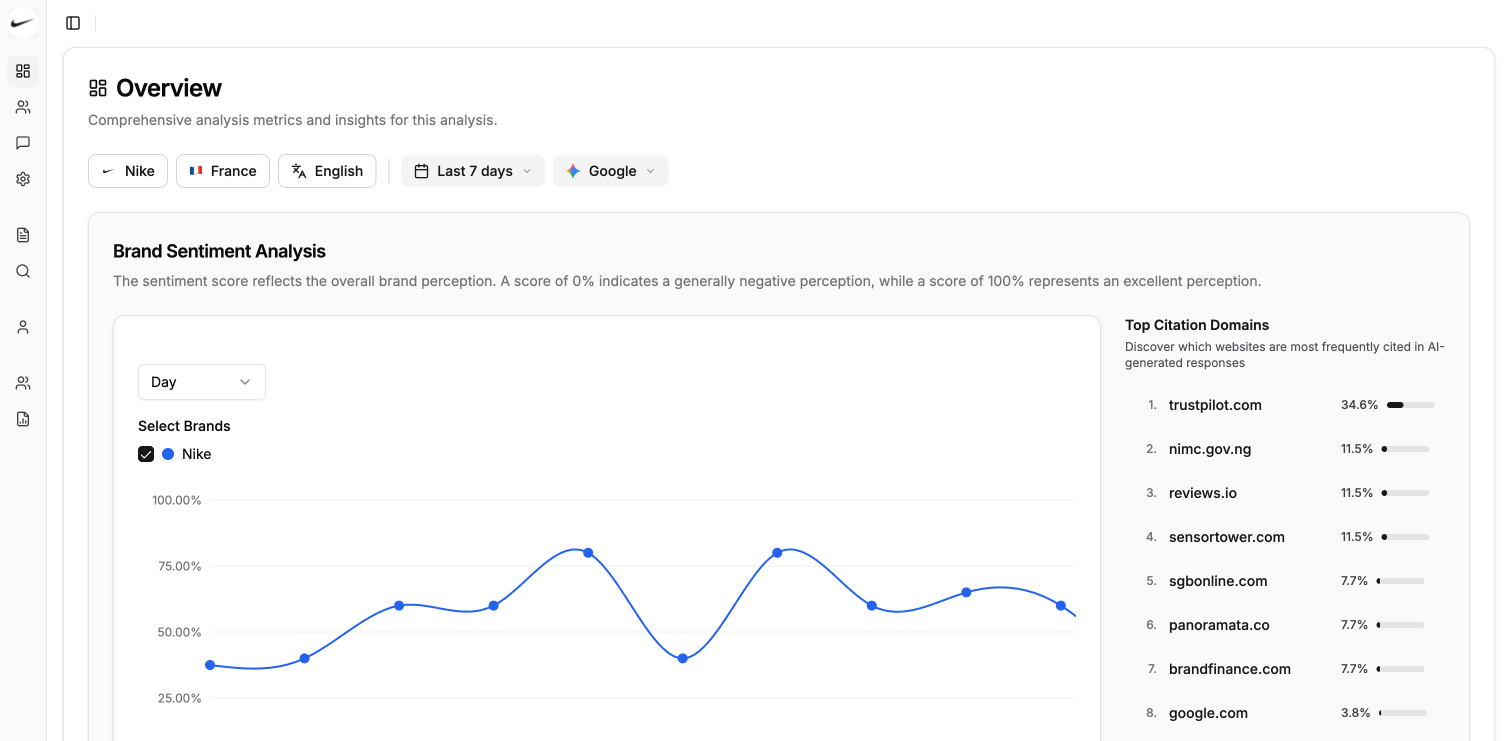
See how your AI visibility evolves
Monitor daily to detect changes after marketing campaigns, product launches, and PR pushes. Spot competitor moves before they impact your bottom line.
Imagine Nike launches a new "Air Max" campaign. Within 48 hours, you can see whether ChatGPT started recommending Air Max more in "best casual sneakers" queries — or whether Adidas Samba still dominates that conversation.
Turn insights into strategy
Identify content gaps, improve product positioning, and influence how LLMs talk about your brand with targeted content, SEO, and PR moves.
If data shows that Claude always associates Nike with "expensive" while recommending New Balance as "affordable performance," you know exactly where to produce content: create articles and landing pages about Nike's value-tier lineup to shift that AI narrative.
Claude 3.5 associates Nike with "premium/expensive" 80% of the time. Competitors like New Balance own the "value" narrative. Create content highlighting Nike's sub-$100 lineup.
Personas searching for "best trail shoes" receive generic answers. Nike's Pegasus Trail 5 is never mentioned. Create a dedicated comparison blog post targeting this gap.
After last month's content push, Nike Vaporfly is now recommended in 67% of marathon shoe queries across GPT-4o and Gemini — up from 23%.
Frequently Asked Questions
Everything you need to know about tracking your AI performance.
AI visibility is how often — and how well — your brand shows up in answers generated by AI systems like ChatGPT, Claude, and Gemini. It's not just about being mentioned, but being recommended, trusted, and correctly positioned when users ask questions about your category.
User behavior is shifting from search to answers. Instead of clicking links, people ask AI directly what to buy, use, or trust. If your brand isn't correctly represented in those answers, you're invisible at the moment decisions are made.
We track the most influential models including OpenAI's GPT series (ChatGPT), Anthropic's Claude, Google's Gemini, Meta's Llama, and Perplexity. We continuously add new models as they gain adoption and impact real user behavior.
SEO is about ranking pages. AI visibility is about controlling answers. LLMs don't just retrieve links — they synthesize information and generate a single response. That means your brand can be misrepresented, ignored, or outperformed even if you rank #1 on Google.
nBlick simulates real user prompts across different personas, runs them through multiple AI models, and analyzes how your brand appears in the responses. You get structured insights on visibility, sentiment, positioning, and why competitors are being recommended over you.
AI answers change depending on who is asking. A CTO, a marketer, or a founder will get completely different responses for the same question. Personas let you simulate these contexts so you understand how different audiences see your brand inside AI.
Yes. You can add competitors and see exactly when and why AI models recommend them instead of you. We show you your share of presence, positioning differences, and the gaps you need to close.
We run simulations continuously and refresh your data daily. This lets you detect shifts caused by model updates, competitor moves, or your own marketing efforts almost in real time.
You can improve how your brand is described, when it gets recommended, and which use cases you win or lose in. nBlick helps you identify missing narratives, weak positioning, and content gaps that influence AI-generated answers.
We do both. First, we show you exactly how AI models perceive your brand. Then we help you act on it — with concrete recommendations to improve your content, messaging, and presence so future answers change in your favor.
No — but it's the next layer. SEO gets you indexed. AI visibility determines whether you're actually recommended. The companies that win will optimize for both.
nBlick is built for marketing, growth, and strategy teams who want to understand and control how their brand is perceived in AI. It's especially valuable for B2B, SaaS, and competitive markets where recommendations drive revenue.
Own your story in the age of AI
Get the data, find the gaps, and start shaping your narrative in the LLM era today.